


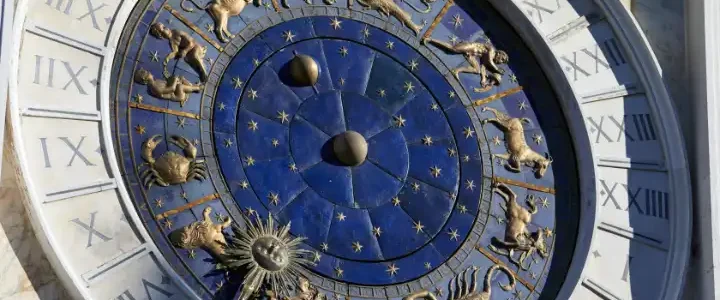
Zodiac Explained
The zodiac, in astrological terms, is a belt-shaped region of the sky that extends approximately 8-degrees north or south of the ecliptic – the plane of earth’s orbit around the sun over the course of a year.
It contains 12 constellations, the astrological ‘signs’ we are so familiar with today, each making up a twelfth of its circle: Aries ( March 21-April 19), Taurus (April 20-May 20), Gemini (May 21-June 20), Cancer (June 21-July 22), Leo (July 23-Aug. 22), Virgo (Aug. 23-Sept. 22), Libra (Sept. 23-Oct. 22), Scorpio (Oct. 23-Nov. 21), Sagittarius (Nov. 22-Dec. 21), Capricorn (Dec. 22-Jan. 19), Aquarius (Jan. 20 to Feb. 18) and Pisces (Feb. 19 to March 20)
These astrological signs form an ecliptic coordinate system which then turns and twists in relevance with latitude (the ecliptic) and longitude (the sun’s position at vernal equinox).
The History of the Zodiac
While astrology is not a science, there’s a long, fascinating history behind humans attaching meaning to the stars. The zodiac was first discovered over 500 years ago, as early as the 14th century BC, when the Egyptians displayed a list of 36 constellations on the tomb, Seti I.
The passage of the Sun through the zodiac is a cycle that was used by ancient cultures to determine the time of year. Most of the planets in the solar system have orbits that take them near the ecliptic plane, within about 8 degrees above or below.
The division of the ecliptic into the astrological signs dates back to the first half of the first millennium BC in Babylonian astronomy. The zodiac contains stars that were first visible in Babylonian star discoveries (such as the MUL.APIN catalogue which was cerated in around 1000 BC) but it wasn’t until the end of the 5th century that they actually began to divide the ecliptic into 12 signs. Each sign is said to command 30 degrees of the zodiac.
The closest constellation to the sun at the time of someone birth determines which zodiac sign they are.
However, the earth’s axis and rotation has altered the positions of the constellations since the signs were created, so that the period for Capricorns is December 22nd to January 19th even though an eclipse on January 1st would be Sagittarius.
The Animals
Today, the signs have developed significantly since those Hellenistic times, morphing into westernisation through the use of animal representation. Now, each sign in Western astrology represents a specific animal or aspect:
 Aries (The Ram)
 Taurus (The Bull)
 Gemini (The Twins)
 Cancer (The Crab)
 Leo (The Lion)
 Virgo (The Virgin)
 Libra (The Scales)
 Scorpius (The Scorpion)
 Sagittarius (The Centaur-Archer)
 Capricorn (The Sea-Goat)
 Aquarius (The Water-Bearer)
 Pisces (The Fish)
This is especially interesting when considering the fact that the word zodiac comes from the Greek ζῳδιακός (zōidiakos), translating to the ‘circle of animals’. The largest of the 12 zodiac constellations is Virgo, covering 1294.43 square degrees of the southern celestial hemisphere, closely followed by Aquarius which covers 979.85 square degrees.
What Are The Symbols Made From?
But what actually makes up those zodiac symbols? What do they consist of?
If you know your star sign, you’ve likely heard of what element it is associated with, either Earth, Air, Fire or Water. These elements of astrological signs (also called triplicities in modern astrology) are used as a way to describe the symbol and their typical character traits. For instance, fire signs are often believed to be independent extroverts, while earth signs are grounded with responsibility and practicality.
Aries, Leo, and Sagittarius are fire signs; Taurus, Virgo, and Capricorn are Earth signs; Gemini, Libra, and Aquarius are air signs; and Cancer, Scorpio, and Pisces are water signs.
In addition to the four elements, there are also three modalities involved in the makeup of a zodiac symbol, also known as ‘qualities’ and ‘quadruplicities’ – Cardinal, Fixed and Mutable. Just like the elements, each sign is associated with one modality or quality, and they can be depicted in the seasons of the year. The first part of the season corresponds to the cardinal modality (new beginnings), the middle of each season corresponds to the fixed modality (stability, reliability) and the final third of each season corresponds to the mutable modality (change, flexibility).
Today’s Use
In the 21st century, the zodiac has been used in much more simplistic terms, namely to describe or predict compatibility between couples and personal fortune.
We’ve all heard of those daily horoscopes, the comforting feeling of a podcast or morning news article to predict your day or week ahead. Personalities are confusing, fluid and changeable, and with emotions playing a big part in any relationships, we as humans are naturally wired to want to make sense of it all.
Thankfully, our experts are on hand to help. Here at Nirvana Light we have a group of experienced psychics and clairvoyants who really care about your needs, undertaking compassionate psychic readings via a range of platforms, from phone and text readings to web chat.
Our online psychics are fully tested and hand-picked for their wealth of skills and authenticity. We can provide clarity on love and relationships, psychic readings for work, home or family, from trusted psychics with years of experience in offering professional, online psychic readings – day or night.
Get in touch with us now to get guidance today!